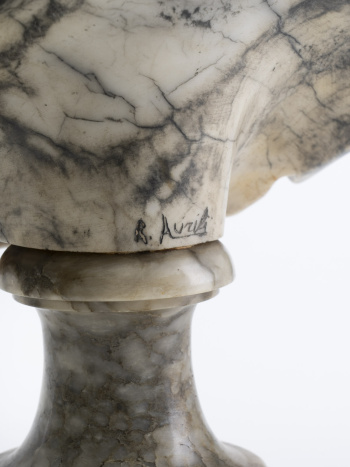
Publisher/Manufacturer : Richard Aurili’s workshop
Production period : 1900's
Country of production : France
Materials : Carved and polished alabaster; veined polychrome marbles in grey, pink and brown; applied gilt-metal ornaments; base in veined grey marble
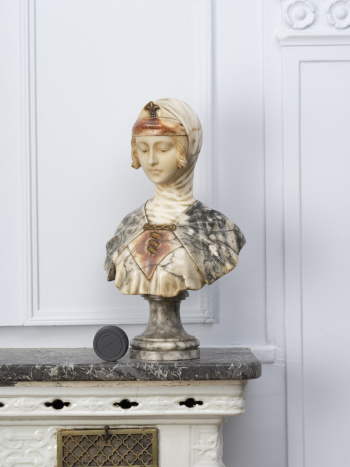
Dimensions : 12 x 43 x 29 cm
COL RA 01
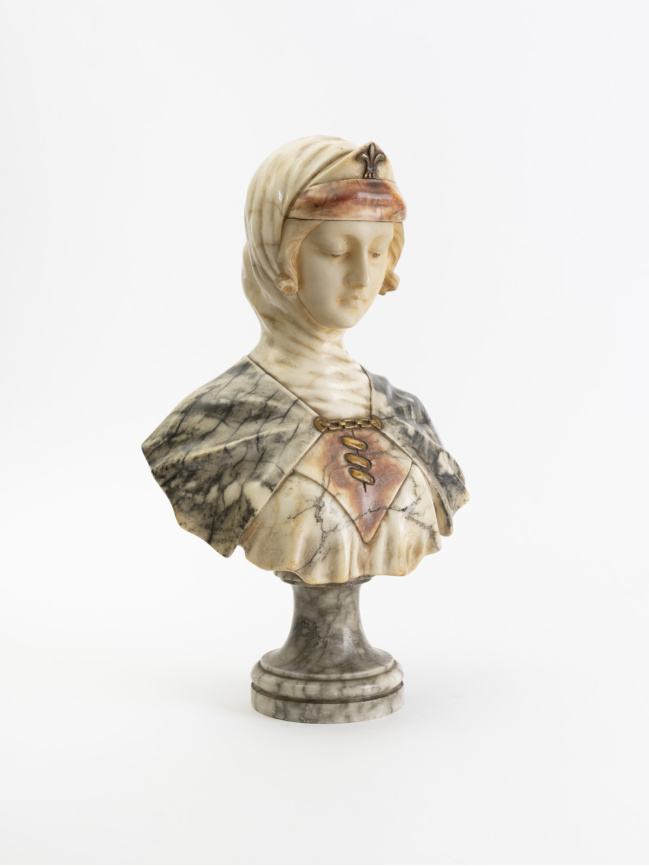
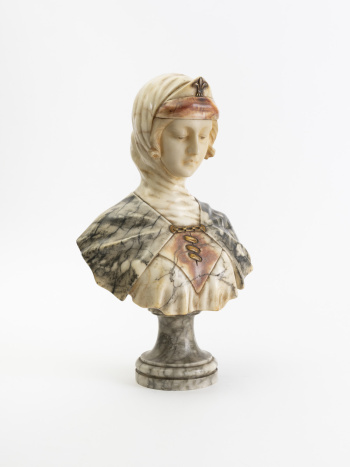
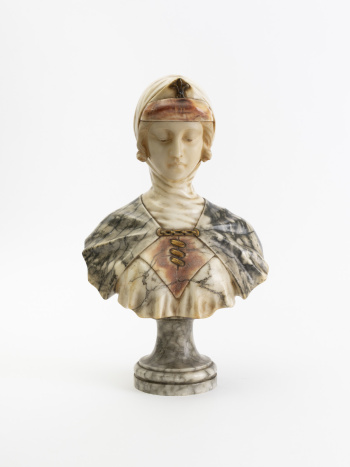
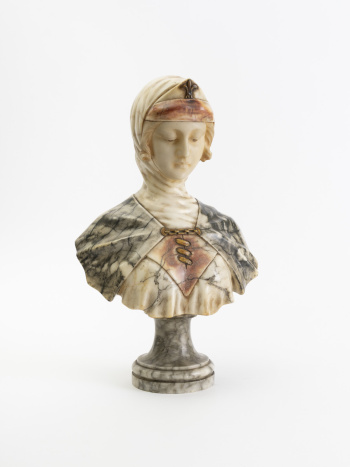
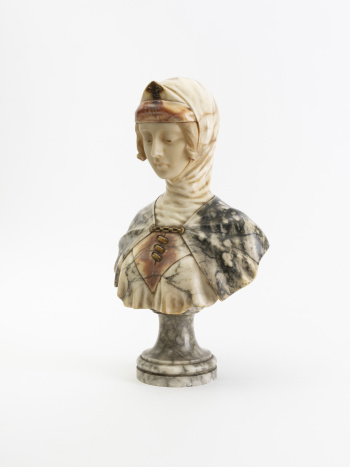
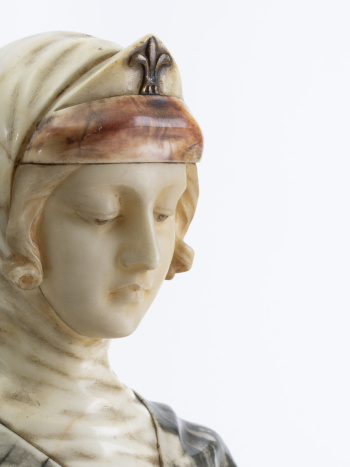
Created around 1900 by Richard Aurili, this bust of a young woman reflects the late nineteenth-century taste for idealised historical figures and the decorative effects of polychrome sculpture. Carved from pale marble, the face is distinguished by its smooth, restrained modelling: the lowered eyelids, closed lips and slight inclination of the head lend the figure an expression of quiet contemplation.
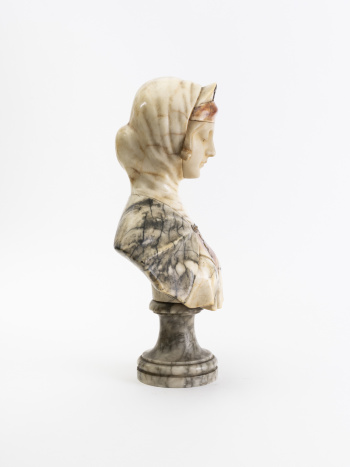
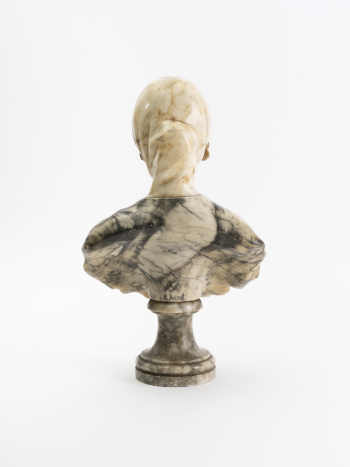
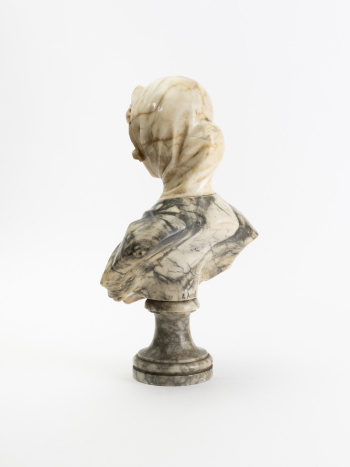
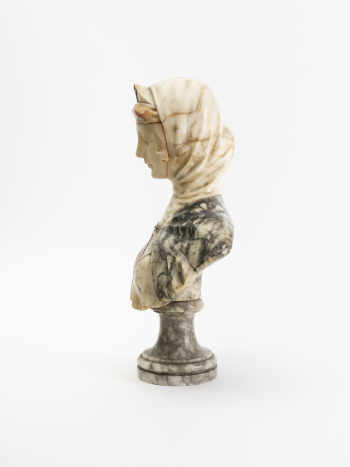
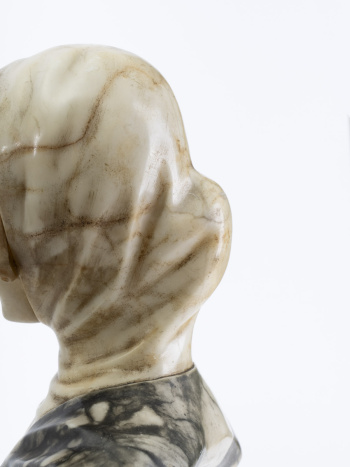
The headdress and costume, freely inspired by the Middle Ages, combine several marbles with contrasting veining. The grey-black cloak frames the whiteness of the neck and bodice, while the pink tones of the headband and neckline subtly enliven the composition. Applied gilt-metal ornaments—the fleur-de-lis, clasps and fastenings—heighten its precious character and introduce a play of light across the surface of the stone.
Carved separately, polished and then assembled with precision, these different elements demonstrate a virtuosic command of polychrome marble. Poised between an idealised portrait and a historical evocation, the work transforms an anonymous figure into a timeless image of nobility and melancholy.
Riccardo Aurili
Riccardo Aurili, also known as Richard Aurili, was an Italian sculptor of the late nineteenth and early twentieth centuries, heir to the Florentine academic tradition. Trained at the Academy of Fine Arts in Florence, he developed a body of work characterized by mastery of modeling, anatomical precision, and great sensitivity in the representation of the human figure. Active in Italy, France, and Belgium, he took part in the major currents of European sculpture of his time, creating busts, allegorical figures, monumental works, and decorative sculptures. His work reflects a dialogue between the Italian classical heritage and the aesthetic developments of the late nineteenth century, particularly in compositions inspired by mythology, history, and nature. Some of his works, produced in small editions, also testify to the close relationship between sculpture and the decorative arts, characteristic of this period. Today sought after by collectors, his sculptures illustrate the richness of a body of work situated between academic tradition, decorative refinement, and artistic expression
Our selection Home
Created around 1900 by Richard Aurili, this bust of a young woman reflects the late nineteenth-century taste for idealised historical figures and the decorative effects of polychrome sculpture. Carved from pale marble, the face is distinguished by its smooth, restrained modelling: the lowered eyelids, closed lips and slight inclination of the head lend the figure an expression of quiet contemplation.
The headdress and costume, freely inspired by the Middle Ages, combine several marbles with contrasting veining. The grey-black cloak frames the whiteness of the neck and bodice, while the pink tones of the headband and neckline subtly enliven the composition. Applied gilt-metal ornaments—the fleur-de-lis, clasps and fastenings—heighten its precious character and introduce a play of light across the surface of the stone.
Carved separately, polished and then assembled with precision, these different elements demonstrate a virtuosic command of polychrome marble. Poised between an idealised portrait and a historical evocation, the work transforms an anonymous figure into a timeless image of nobility and melancholy.