Publisher/Manufacturer : François Azambourg
Production period : 2010's
Circa : 2015
Country of production : France
Special features : It belongs to the emblematic Very Nice series, whose original 2003 prototype is held in the collection of the Musée National d’Art Moderne – Centre Pompidou.
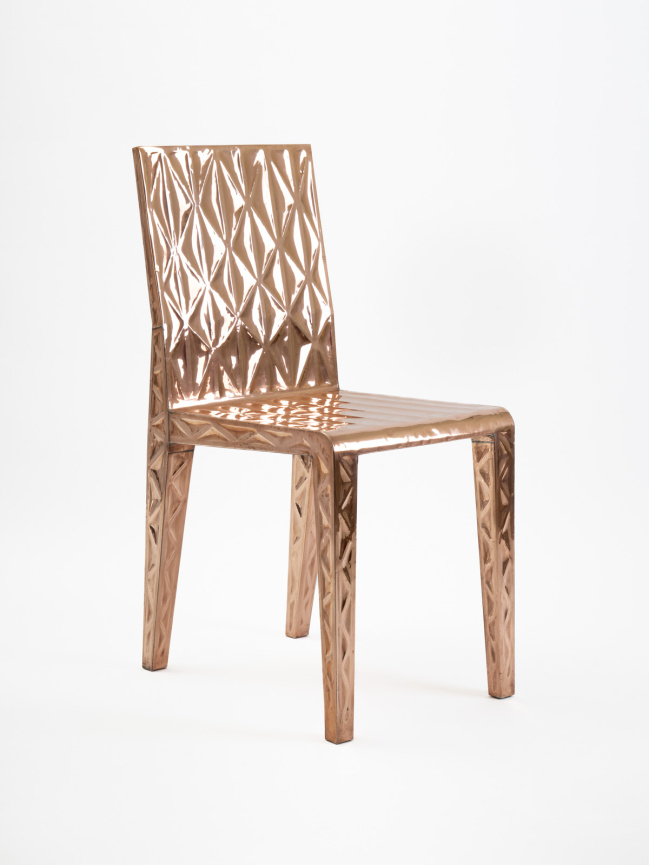
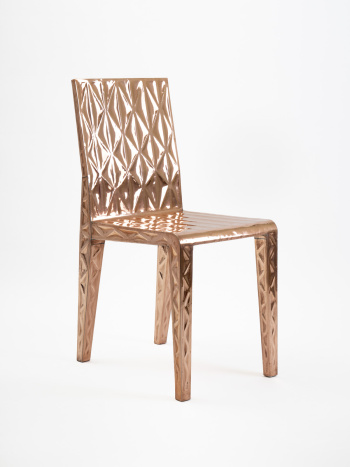
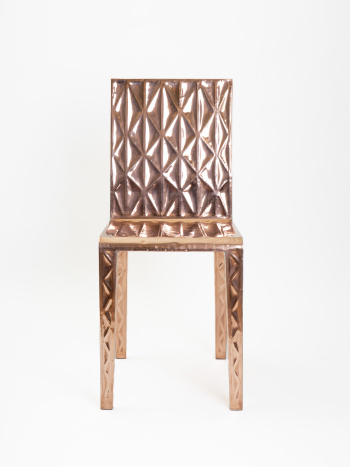
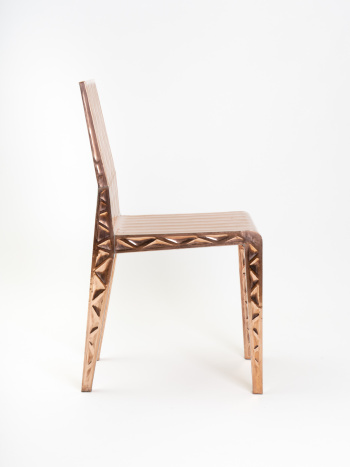
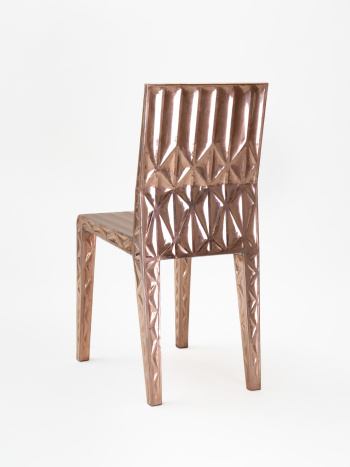
Materials : Triangulated birch plywood structure; 0.3 mm red copper sheet covering, embossed and formed directly over the frame, then joined by tin soldering.
Dimensions : 49 x 83 x 36 cm
COL FA 01
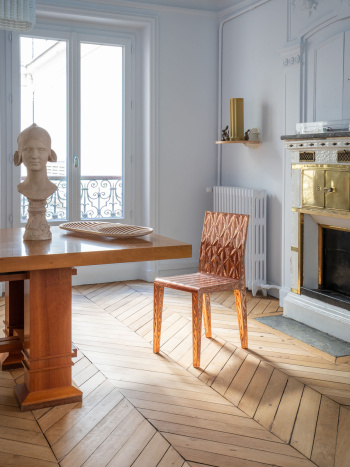
Designed in 2007 by François Azambourg, the Very Nice Copper chair extends his research into economy of material and structural lightness. Its triangulated birch plywood frame is wrapped in an extremely thin sheet of red copper, embossed and formed directly over the wooden skeleton, then joined by tin soldering. Rather than concealing the chair’s construction, the metal skin reveals it, transforming the structural reinforcements into a graphic network.
Its value lies both in the refinement of the process and in the evolving nature of copper, whose surface retains the marks of hand-forming and gradually develops a distinctive patina. Produced in France by François Azambourg for a limited period between 2015 and 2016, this version remains particularly rare. The original Very Nice chair, made from plywood and heat-shrink polyester film, is held in the collection of the Centre Pompidou.
François Azambourg
François Azambourg is a French designer whose practice is distinguished by a constant exploration of materials, manufacturing processes, and resource efficiency. Trained at the École nationale supérieure de création industrielle, he has developed a practice situated between industrial design, technical experimentation, and environmental reflection. His work explores the hidden potential of materials, which he repurposes and transforms to reveal new functional and aesthetic qualities. His furniture collections reflect this approach, notably the Bugatti and Very Nice chairs, which illustrate his interest in lightness, structure, and the optimization of forms. Through collaborations with international publishers, François Azambourg has helped renew the language of contemporary design through an approach that is at once inventive, rational, and sensitive. His works are included in the collections of several institutions dedicated to design and decorative arts.
Our selection Home
Designed in 2007 by François Azambourg, the Very Nice Copper chair extends his research into economy of material and structural lightness. Its triangulated birch plywood frame is wrapped in an extremely thin sheet of red copper, embossed and formed directly over the wooden skeleton, then joined by tin soldering. Rather than concealing the chair’s construction, the metal skin reveals it, transforming the structural reinforcements into a graphic network.
Its value lies both in the refinement of the process and in the evolving nature of copper, whose surface retains the marks of hand-forming and gradually develops a distinctive patina. Produced in France by François Azambourg for a limited period between 2015 and 2016, this version remains particularly rare. The original Very Nice chair, made from plywood and heat-shrink polyester film, is held in the collection of the Centre Pompidou.