Publisher/Manufacturer : Ateliers Émile Gallé
Production period : Art Nouveau
Circa : 1900
Country of production : France
Special features : A representative example of the naturalistic furniture of the École de Nancy. Comparable tea tables by Émile Gallé are held by the Musée d’Orsay.
Materials : Moulded and carved walnut structure; veneered tops decorated with marquetry in various wood species; incised and engraved details.
Dimensions : 55,5 x 72,5 x 37 cm
Condition : Good condition
COL EG 01
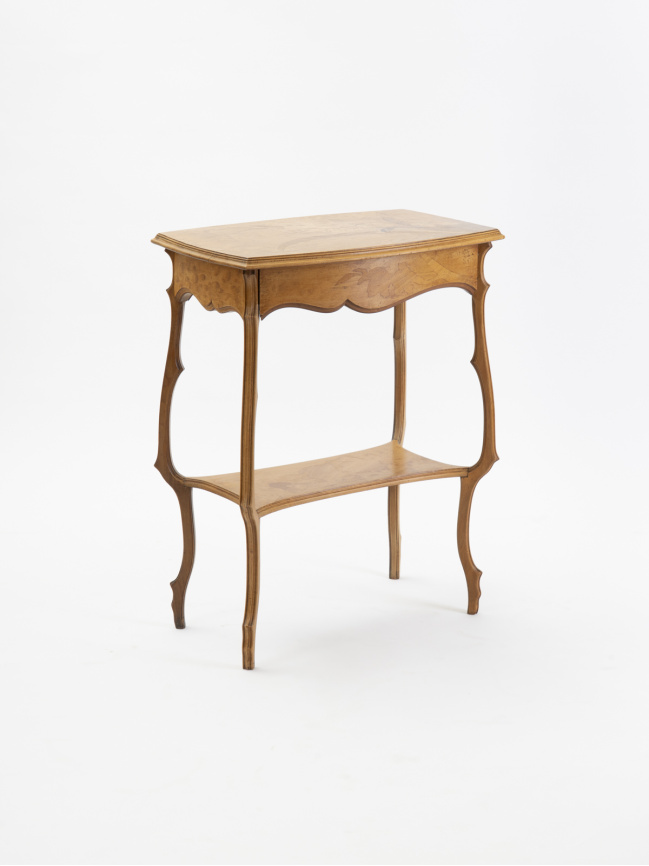
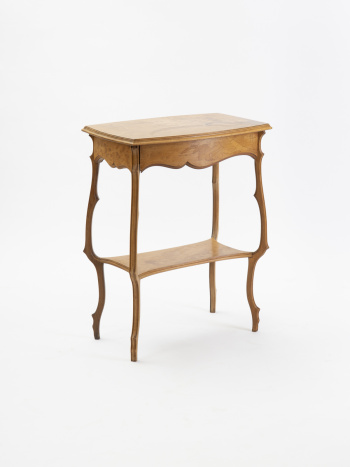
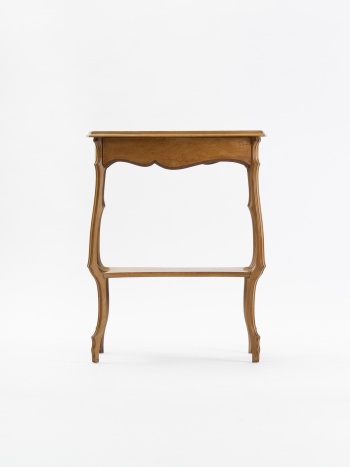
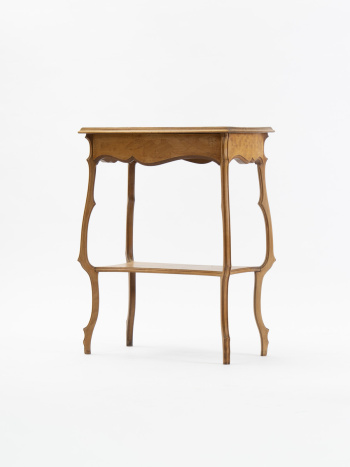
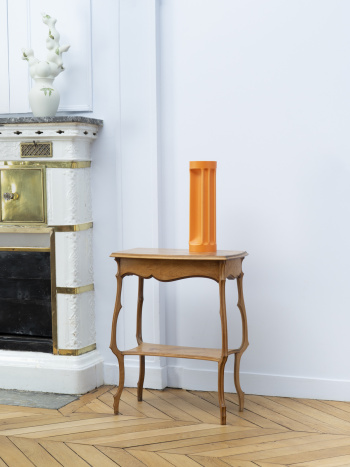
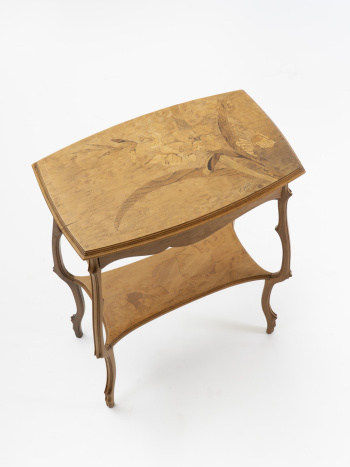
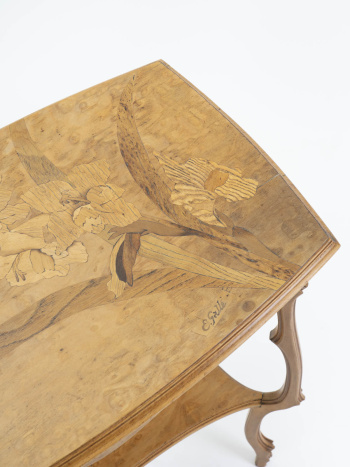
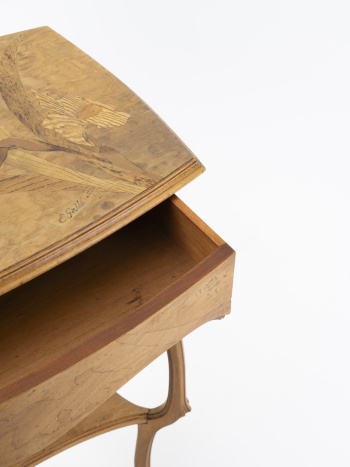
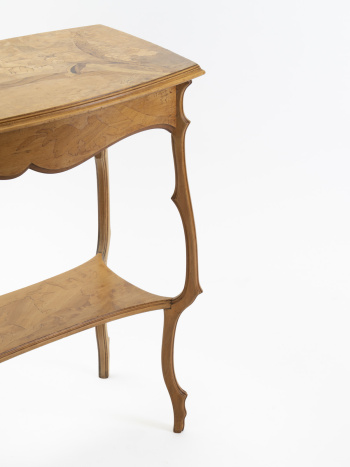
Made around 1900 in Émile Gallé’s workshops in Nancy, this two-tier tea table illustrates the renewal of furniture design promoted by the École de Nancy. Its slender structure, articulated by four cabriole legs with plant-like contours, replaces traditional geometry with an organic continuity linking the legs, apron and table surfaces. The upper top, signed “E. Gallé” within the marquetry, features a composition of orchids whose stems, petals and foliage appear to extend the flowing curves of the furniture.
The table most likely combines a moulded and carved walnut structure with veneered panels and marquetry in various wood species. The pieces of veneer, precisely cut and fitted together, exploit the natural variations in colour and grain to create a botanical image. Incised and engraved details complete the design, making the wood itself the principal means of expression.
Its rarity lies in the quality of its decoration, the signature incorporated into the composition, the complexity of the base and the preservation of both original tiers.The significance of this furniture is confirmed by the collections of the Musée d’Orsay, which holds several tea tables by Gallé, and those of the Musée de l’École de Nancy, where his naturalistic creations occupy a prominent place. At the intersection of functional object, botanical study and work of art, this table ranks among the most refined expressions of Art Nouveau cabinetmaking.
Émile Gallé
Émile Gallé is one of the major figures of French decorative arts in the late nineteenth century and a key protagonist of the Art Nouveau movement. An artist, cabinetmaker, ceramicist, and master glassmaker, he developed a holistic approach to creation in which furniture, decorative objects, and interior architecture all belonged to the same aesthetic language. In his furniture work, Gallé profoundly renewed the traditions of cabinetmaking by combining technical innovation, formal experimentation, and naturalistic inspiration. His pieces, often made of inlaid and carved precious woods, reveal a subtle dialogue between structure, ornament, and symbolism, in which each vegetal motif acquires a poetic dimension. At the head of the Établissements Gallé workshop, he developed a production of exceptional technical rigor, turning furniture into a true medium of artistic expression. His creations, rare and precious, now hold a major place in international collections devoted to decorative arts and the history of design.
Our selection Home
Made around 1900 in Émile Gallé’s workshops in Nancy, this two-tier tea table illustrates the renewal of furniture design promoted by the École de Nancy. Its slender structure, articulated by four cabriole legs with plant-like contours, replaces traditional geometry with an organic continuity linking the legs, apron and table surfaces. The upper top, signed “E. Gallé” within the marquetry, features a composition of orchids whose stems, petals and foliage appear to extend the flowing curves of the furniture.
The table most likely combines a moulded and carved walnut structure with veneered panels and marquetry in various wood species. The pieces of veneer, precisely cut and fitted together, exploit the natural variations in colour and grain to create a botanical image. Incised and engraved details complete the design, making the wood itself the principal means of expression.
Its rarity lies in the quality of its decoration, the signature incorporated into the composition, the complexity of the base and the preservation of both original tiers.The significance of this furniture is confirmed by the collections of the Musée d’Orsay, which holds several tea tables by Gallé, and those of the Musée de l’École de Nancy, where his naturalistic creations occupy a prominent place. At the intersection of functional object, botanical study and work of art, this table ranks among the most refined expressions of Art Nouveau cabinetmaking.